
For insurers, external data powers growth, but only if it can be trusted. Kubrick’s Intelligent Data Intake solution is transforming one of the industry’s biggest data headaches into a scalable competitive advantage.
The file arrives—and the problems begin
It’s Monday morning, and an underwriting team receives a coverholder’s bordereaux in their inbox. An analyst opens it and the frustration begins: column headers have changed, a key field is missing, and several addresses are formatted differently than last month. Before anyone can answer the critical questions, someone has to spend hours cleaning, reconciling, and second-guessing the data.
Meanwhile, reporting slows, risk positions remain unreviewed, and decisions are delayed. Underwriters who should be focused on pricing and portfolio management are instead waiting on data they can’t yet trust.
For many insurers, the same scenario will play out again on Tuesday.
A systemic problem holding back growth
The opportunity to grow portfolios and revenue through external partners is immense. The Managing General Agent (MGA) and coverholder market has been booming, growing at more than 20% CAGR since 2020, enabling insurers to reach new niches, geographies, and customers with agility.
But this growth relies on third-party data—bordereaux from coverholders, claims schedules from brokers—to manage portfolios, monitor risk, and meet regulatory obligations. In this model, inconsistency is intrinsic. Every partner uses its own format, timeline, and interpretation of what each field means. Column names shift, formats drift, and fields appear, disappear, and reappear in new positions.
Standardizing all this to fit your schema is both a major headache and a major risk. If what enters the system can’t be trusted, nothing downstream can.
Why it’s time for a new approach
Most organizations try to fix this with templates, manual mapping, and downstream validation. But managing external data is inherently inconsistent: templates quickly become outdated, manual mapping is slow, error-prone, and non-scalable, and downstream validation catches errors too late—after they’ve delayed reporting or distorted analysis. When schema standardization happens after ingestion, the risk of variance and error increases.
As a result, analysts spend days preparing data instead of analyzing it. Actuaries label outputs with data quality warnings, and underwriters make decisions on exposures they can’t fully trust. The costs appear as lost labor hours, long decision cycles, missed opportunities, and unnecessary losses.
The breaking point: growth meets complexity
As organizations grow, the problem compounds:
- More brokers and coverholders mean more submission formats.
- More products mean more schemas to manage.
- More sources mean more inconsistency.
What was once a manageable inefficiency becomes a barrier to growth. Onboarding coverholders can take weeks, slowing the portfolio expansion it was meant to accelerate. The strategy is sound, but the data processes can’t keep up.
The shift: from ingestion to intelligent intake
To execute partner-driven growth, leadership needs insights on who’s performing well and in which markets. Many insurers have invested heavily in data platforms, reporting, and analytics—but the gap sits at the very start of the pipeline: when external data enters the organization.
Intelligent Data Intake reframes ingestion as more than a technical process. Rather than deferring quality checks downstream, it ensures data is usable at entry—mapped, validated, and governed before it hits analysts’ desks. By the time it reaches underwriters, it’s schema-aligned, quality-checked, and ready to act on.
When schema standardization starts at ingestion, it unlocks true data readiness.
What Intelligent Data Intake makes possible
When intake works properly, the downstream benefits are substantial:
- Automated workflows replace manual data preparation.
- Fragmented inputs become governed, schema-aligned datasets.
- Reporting and exposure analysis accelerate, with greater reliability.
- Intake becomes a scalable organizational capability—not an ad hoc process repeated for every partner.
Kubrick’s Intelligent Data Intake solution is purpose-built for insurance workflows, designed around the industry’s core data types—bordereaux, claims schedules, and third-party submissions. It provides end-to-end ingestion, mapping, validation, and delivery of analytics-ready data.
The solution combines intelligent automation with human oversight to manage real-world complexity: inconsistencies, format changes, and ambiguous fields.
Under the hood of the Intelligent Data Intake solution
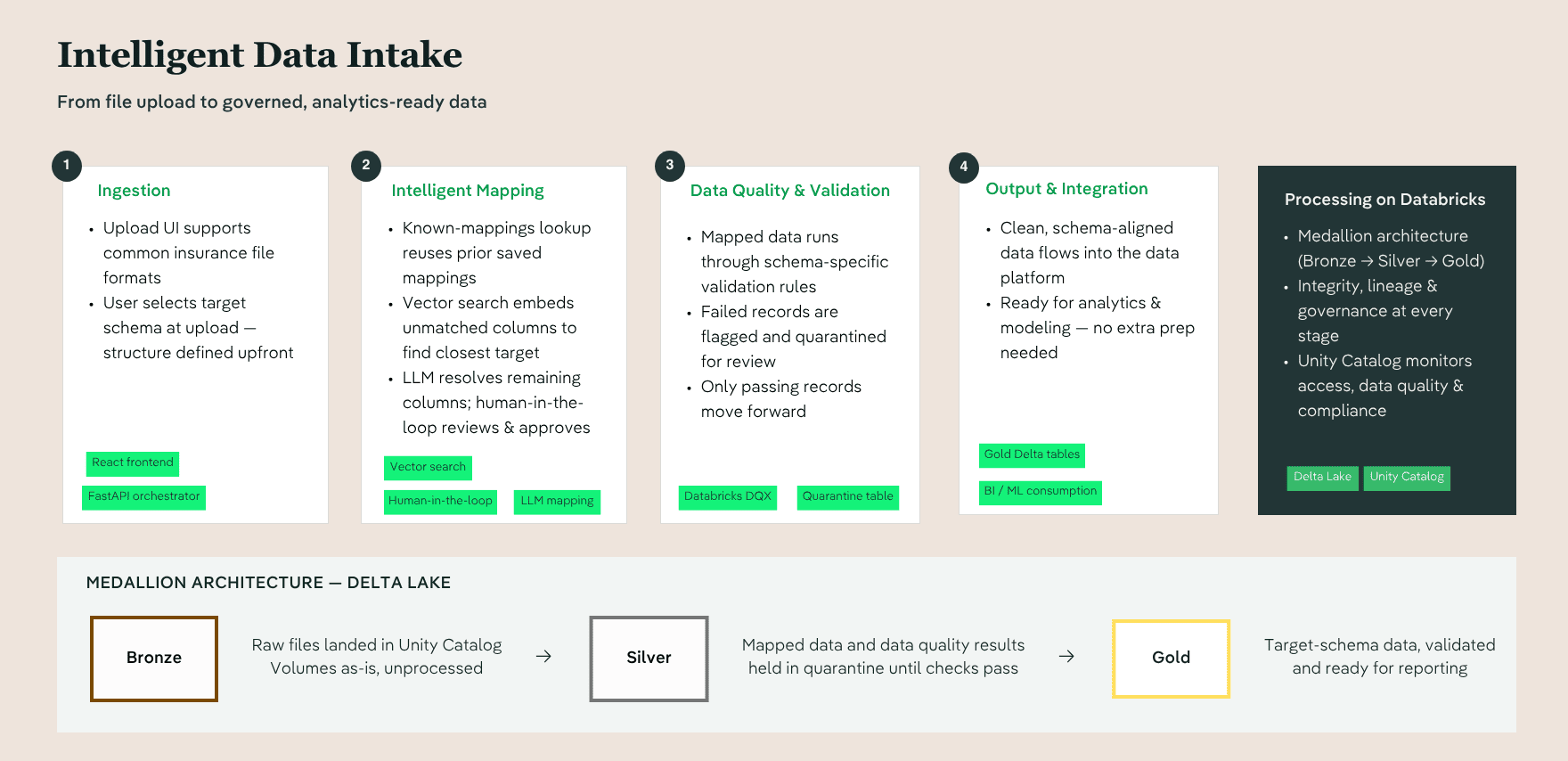
The system includes multiple interconnected layers to tackle each intake challenge to result in a trusted, usable schema:
Ingestion: Files are uploaded via a user interface supporting common insurance formats. Users select the target schema at upload, defining structure from the start.
Intelligent Mapping Engine: AI-assisted mapping—enhanced by human-in-the-loop oversight—minimizes manual effort and learns with every file, reducing repetitive work.
Data Quality & Validation: Once mapped, data passes through schema-specific validation. Anything that fails is flagged for review, preventing bad data from moving forward.
Output & Integration: Clean, validated, schema-aligned data flows directly into the data platform for analytics and modeling—no extra preparation required.
Processing on Databricks: Built on a medallion architecture in Databricks, the solution ensures integrity, lineage, and governance at every stage, with Unity
Data Catalog for monitoring and compliance.
The business outcomes
The impact extends beyond the data team:
- Faster turnaround—usable data aligned to schema in minutes of ingestion, not hours.
- Reduced manual effort, freeing analysts for strategic work.
- Improved confidence in reporting and exposure analysis, with full audit trails.
- Scalable onboarding of new partners, without ballooning operational costs.
Beyond operations: intake as a strategic capability
When intake operates at scale, it unlocks new possibilities:
Underwriters gain confidence in the data underpinning their decisions. Partner relationships improve as frictionless data exchange replaces back-and-forth over file formats. Risk visibility strengthens as exposure data arrives faster and in better shape. And the organization gains the agility to onboard new business sources quickly – without the data integration delays that currently slow growth.
External data stops being a liability and becomes a competitive edge.
The foundation for what comes next
The insurance industry is rapidly investing in AI-driven capabilities: predictive pricing, real-time risk monitoring, automated underwriting. But these innovations are only as strong as the data feeding them—data that still enters through intake processes not built to support them.
By making external data clean and trusted at entry with schema-first ingestion, Kubrick’s Intelligent Data Intake lays the foundation for AI-enabled decision-making. It’s a shift from managing files to activating external data. Because trust in data starts at the front door.
Intelligent Data Intake is part of Kubrick’s Atlas platform of AI solutions, answering board-level questions with strong return on investment.
Learn more about Intelligent Data Intake here.